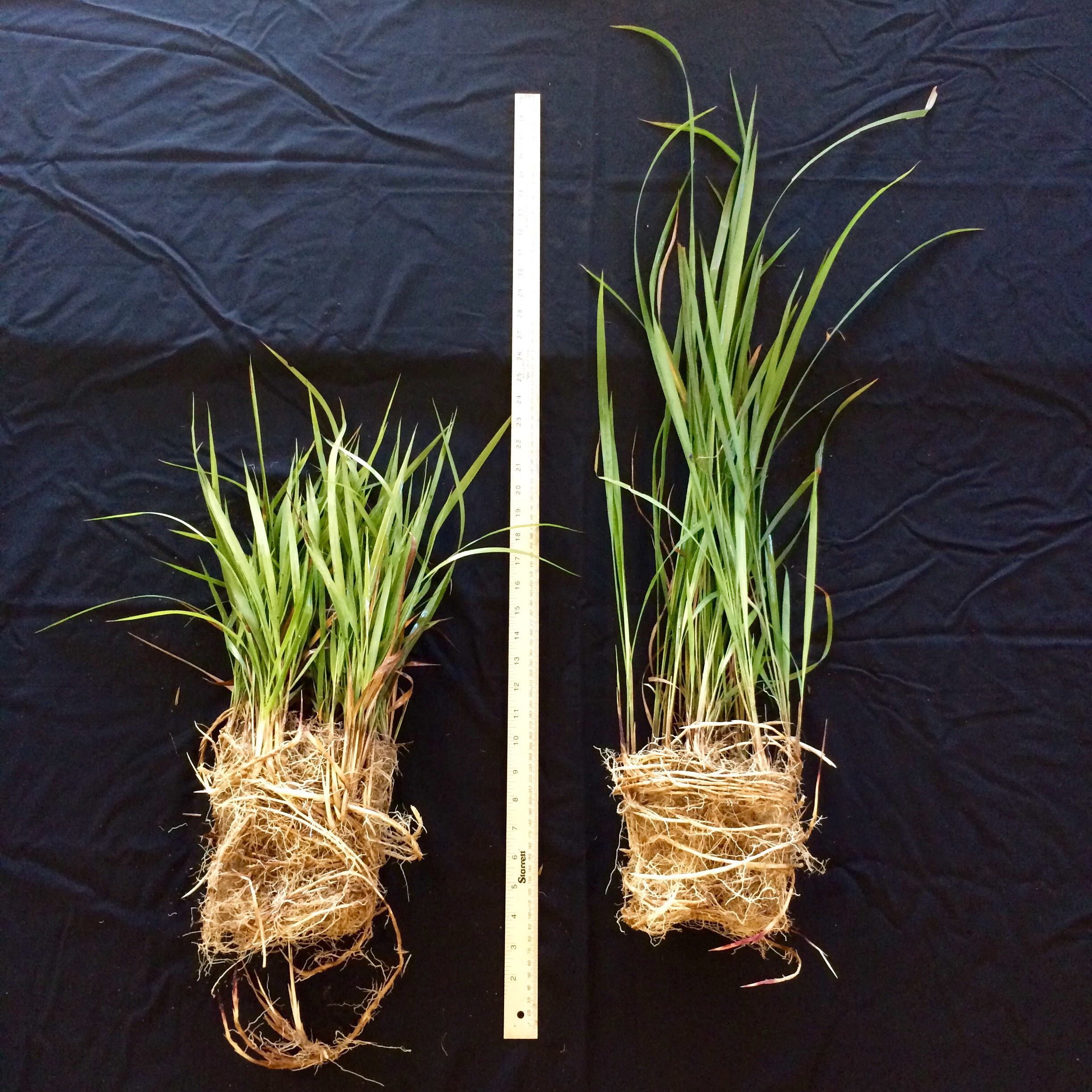
Variation in plasticity among invasive populations and comparison to co-occurring native species
One of the hypotheses for invasion success in new environments is that invasive plants are more phenotypically plastic than native species. We have conducted research looking at variation in plasticity among invader populations and how plasticity compares to co-occurring native species. Results highlight that plasticity varied between genotypes of an invasive grass, and on average invasive populations were more plastic for functional traits than native species. (link to paper)

Accounting for nonlinearity better predicts phenotypic plasticity to multiple stressors
We have also conducted an experiment looking at how plasticity varies across a range of resources. Experiments are often designed with limited resource comparisons, and plasticity is assumed to be linear across large changes in resource availability. In this project we highlight that assuming linear reaction norms can be inaccurate, especially under small changes in resource availability.
Phenotypic variation across multiple light levels (heavy shade to full sun)

Trait data across light availability and high and low water stressors
